
Industry Connect: Guardrails with Inbuilt Noise- Barriers
January 20, 2016
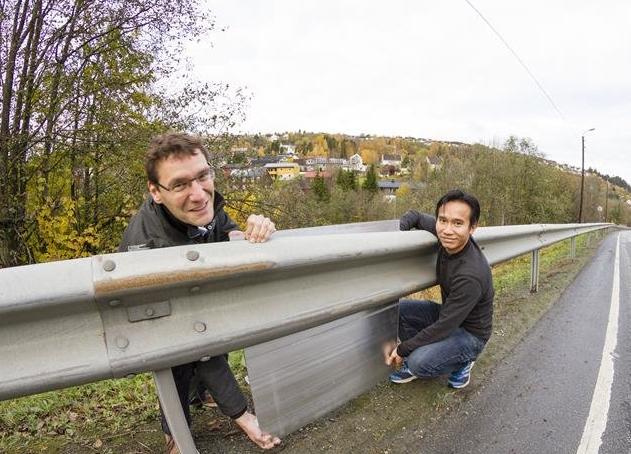
Anyone living near high traffic roads can say they are quite familiar with the bustling sounds of cars. SINTEF Scientists Dirk Nolte (left) and Nguyen Hieu Hoang (right), explored the use of aluminum noise-barriers as a solution to reducing traffic noise with a material that is strong enough to absorb collision.
---
Anyone living near high traffic roads can say they are quite familiar with the bustling sounds of cars. Standard guardrails are often installed where the ground falls away with the roadside, and houses that are to be screened from noise in such locations usually lie lower than the source of the noise.
The Norwegian Public Roads Administration asked SINTEF, the largest independent research organization in Scandinavia, to test how noise-barriers can be integrated into guardrails, and find out what materials should be used in them.
“Several types of guardrail are used on Norway's highway network. Railings on road bridges, for example, are designed to keep cars actually on the road, so these are not subject to the same requirements regarding yielding to the force of a crash as other types of guardrail. Many "stiff" guardrails already incorporate noise barriers, but the Public Roads Administration is now looking for a combined solution for yielding guardrails, which are the most common type of guardrail in use in Norway.”
SINTEF Scientists Dirk Nolte (left) and Nguyen Hieu Hoang (right), explored the use of aluminum noise-barriers as a solution to reducing traffic noise with a material that is strong enough to absorb collision.
"Aluminium is corrosion-resistant, the material is widely used in energy-absorbing systems in many applications and it can easily be worked and recycled. It has a good ability to reflect sound, and transporting it is also energy-efficient because it is light in weight," says SINTEF scientist Dirk Nolte.
If aluminum noise barriers were installed, they would be mounted behind the guardrail post for the sake of simplicity. The configuration has the potential to protect cyclists who fall on the cycle path behind the rail from hitting the posts.
According to senior engineer Finnanger, the Public Roads Administration intends to start with testing designs that have been validated through virtual testing by SINTEF's computer model; that is, with noise-barriers mounted on the rear of the guardrail posts.
---
For more information on the study, refer to the full article here at Science Daily.