
Grout Injection: Preserving Shaker History
November 13, 2013
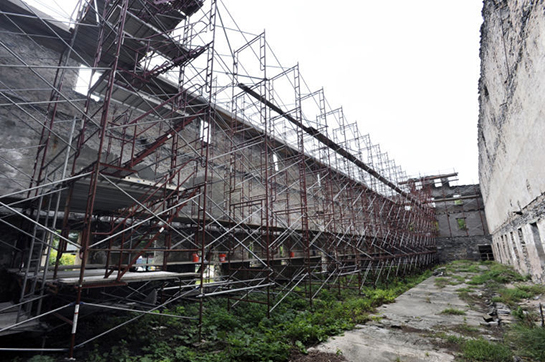 Photo & Caption from the Chatham Courier: Scaffolding runs the length of the building but is not attached. According to project manager Mike Mucci, it required the better part of a month to erect.
The Great Stone Bar at the Shaker Museum in Mount Lebanon New York, is being restored by Allegrone Masonry through a process of stabilization.
The original barn, built in 1859, was designed by North Family Elder Frederick Evans. The foot-print of the large stone barn, stands at 50-feet wide, 200-feet long and four stories high.
Allegrone Masonry has been brought on to help with the $1.9 million stabilization project, which aims to restore and preserve this historical landmark
The restoration of the barn ins being funded in part by a Save America’s Treasures grant through the U.S. Department of the Interior and the National Park Service. A number of restoration efforts are being completed by Allegrone, including the use of grout injection (see video above). This is when a liquid grout is injected into the interior of the walls, which shores up the structure. The outside walls are also being repointed.
“Allegrone performed an analysis of the existing cement used when the barn was originally constructed and also tested the strength and chemical breakdown of the cement.
While Mucci said the most common type of cement used today is Portland cement, the original cement used on the barn, lime cement, is not currently found in the United States, so they had natural hydraulic lime cement imported from England. He noted that this cement has more properties similar to the cement used more than 100 years ago than cement today, which has so many different properties.
‘We are mixing that cement with local sand; that mixture is very similar to the original one used when the barn was first built,’ said Mucci.”
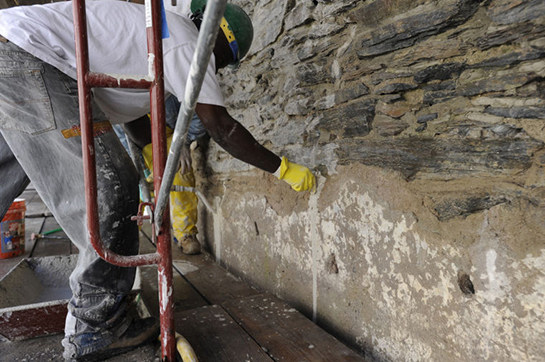 Photo & Caption from the Chatham Courier: Mortar is injected until it comes out of one of the neighboring holes. Harold Lawrence puts a clay plug into each hole to keep the mortar from running out.
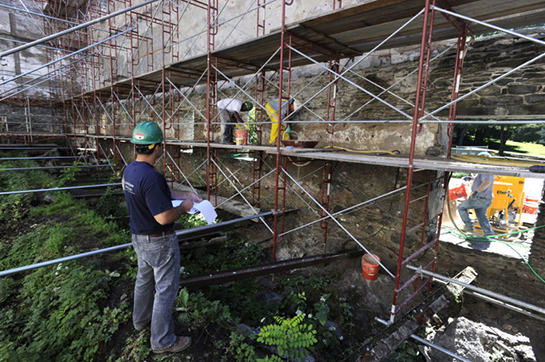 Photo & Caption from the Chatham Courier: While project manager Mike Mucci records the amount of grout injected into each hole, Dave Schilling injects the grout and Harold Lawrence follows with clay as a stopper for each hole when it is filled. Outside, mason foreman George Depuy tends to the cement mixer.
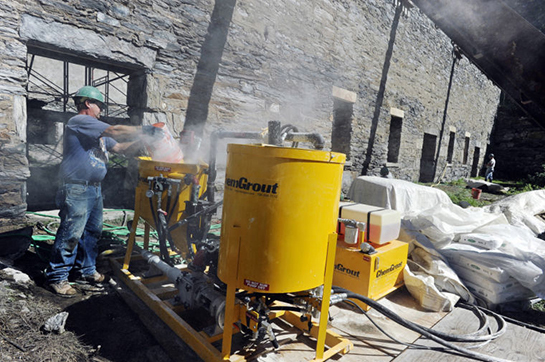 Photo & Caption from the Chatham Courier: Foreman George Depuy replenishes the cement machine, but not just any ordinary cement mixer — the ChemGrout. It keeps the mixture very smooth and viscous and controls injection pressure, which moves the mortar along without being so strong as to cause damage.
There is also a wonderful exhibition “The Great Stone Barn Project” which is curated by museum board Trustee Peter Watson and the Historic Site Committee. The exhibit gives an overview of the history of the barn, it’s construction, and it’s role in Shaker life. Be sure to check it out here >>
Read the full article here: The Chatham Courier, Preserving Shaker History — One Stone at a Time, by Katie Kocijanski, November 13, 2013.